 Click To Email
 Call us +1 315 530-1099


Designing Within Constraints: A Real-World Site Plan Story from Sherrill, NY

Sometimes the most interesting projects aren’t the wide-open sites—they’re the ones that make you think. That was exactly the case for this commercial building in Sherrill, NY, where a local business owner wanted to expand. On paper, it sounded straightforward: add more usable space and improve the layout. In reality, the site told a different story.
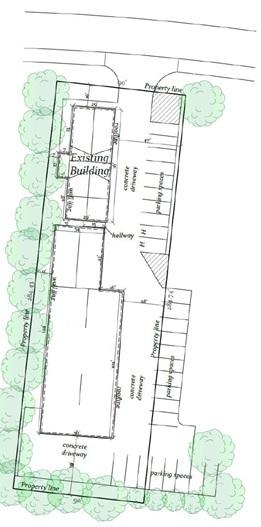
Starting with What Was There The property is just under an acre—about 0.59 acres—with an existing commercial building and established parking areas. Like many properties in developed commercial corridors, it was already doing a lot with limited space. There wasn’t a big empty area waiting for expansion. Every square foot already had a purpose.
The Reality Check: Zoning Isn’t Optional Before sketching anything new, we had to work through the zoning framework. And while zoning often feels like a constraint, it’s really more like a set of guardrails.
In Sherrill, those rules are designed to:
Keep traffic flowing safely Prevent overcrowded sites Ensure businesses have enough parking to function well
For this project, one rule mattered more than anything else: If you add space, you need more parking. That’s standard in most municipalities, and Sherrill is no different. Commercial uses must provide adequate off-street parking, and the Planning Board looks closely at how traffic and parking will work in real life—not just on paper.
The Classic Problem: Space vs. Parking As we started designing the addition, the challenge became obvious. The expansion increased the building footprint from about 30% coverage to 35% of the site.
That’s great for the business—but it comes with a catch: More building = more required parking. And parking doesn’t come free—it eats up land.
So we hit the core tension:
Expand the building → lose space for parking Add parking → lose space for the building
It’s a balancing act every site designer knows well.
The Turning Point: Looking Beyond the Property Line Instead of trying to force everything onto one site, we stepped back and looked at the bigger picture. Sherrill’s zoning code allows required parking to be located within 200 feet of the primary building, subject to approval. That small but powerful provision changed everything. The Solution: Shared Parking Through Neighbor Agreements
By leasing parking spaces from neighboring properties, we were able to:
Reduce how much parking had to fit on-site Preserve room for the building addition Stay fully compliant with zoning requirements
This wasn’t a workaround—it was exactly the kind of flexibility zoning is meant to allow when used thoughtfully.
What the Final Plan Achieves Once parking was no longer the limiting factor, the site plan came together in a much more natural way.
- A Meaningful Building Expansion The business gets the additional space it needs to grow—without forcing an awkward or compromised layout.
- Smarter Traffic Flow Driveways, parking areas, and circulation paths are more clearly defined, which makes the site safer and easier to use.
- Efficient Use of Land Instead of over-paving the site with parking, we used a mix of on-site and nearby spaces to keep things balanced.
- Clean Zoning Compliance No variances. No overreaching. Just a plan that works with the rules instead of against them.
Why This Approach Matters What makes this project stand out isn’t just the design—it’s the mindset behind it.
It would have been easy to say:
“The site is too tight” “We need a variance” “There’s no room to expand”
But instead, we asked:
What flexibility already exists in the code—and how can we use it?
That’s where good site planning lives.
The Bigger Takeaway Every site has constraints. Zoning, parking, setbacks—they’re all part of the puzzle. But constraints don’t have to stop a project. In fact, they often lead to better solutions. At 227 W. Seneca Street, the key wasn’t squeezing more into the lot—it was:
Understanding the rules deeply Thinking beyond property lines Collaborating with surrounding properties
And in the end, we didn’t just fit the expansion onto the site—we made the whole area work smarter.
If you're dealing with a tight property or zoning challenges, there’s usually more flexibility than it first appears—you just have to know where to look.