 Click To Email
 Call us +1 315 530-1099



Case Study: Foundation Settlement Assessment & Engineering Recommendations

Engineering Evaluation of Foundation Settlement in Troy, NY
Foundation cracking is one of the most common structural concerns for property owners throughout the Northeast. In this Troy, New York multifamily property, the client requested a professional engineering evaluation after observing visible cracks on both the interior and exterior foundation walls.
NextBLDG Architecture & Engineering, P.C. conducted a structured preliminary visual assessment aligned with ACI 364.1R-19 methodology. Our objective was to document existing conditions, evaluate structural behavior, determine whether settlement was ongoing, and outline a practical stabilization strategy.
At NextBLDG, we combine structural engineering analysis with architectural and site-level evaluation. This integrated approach allows us to move beyond documenting cracks and instead identify root causes, risk levels, and clear remediation pathways that support informed decision-making. Call our architects in Albany and throughout NY if you have any questions about your facility or building.
Project Overview
Client Concern
The property, constructed in 1991, exhibited significant cracking in the basement and exterior foundation walls. The client’s primary concern was whether the observed cracks indicated:
- Active structural movement
- Long-term differential settlement
- Immediate safety risk
- The need for major structural intervention
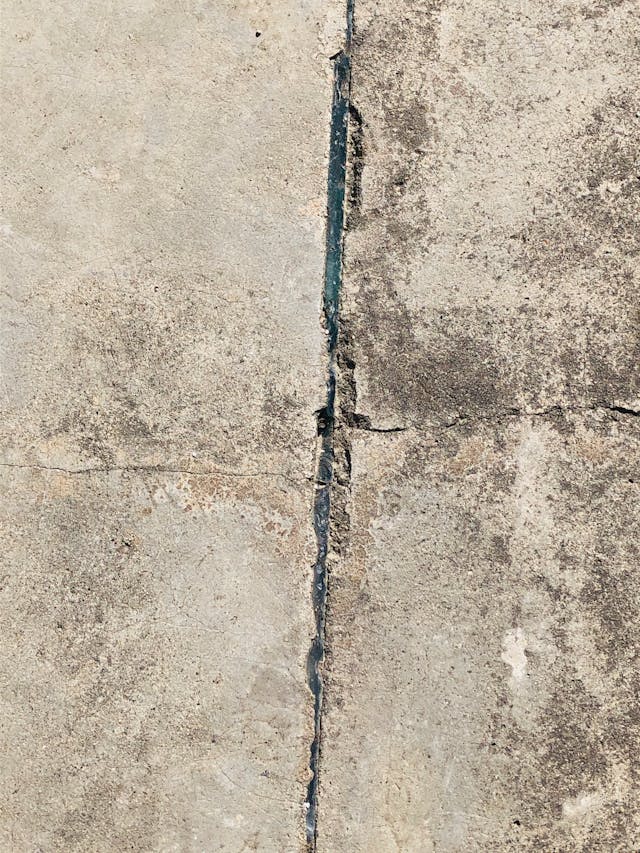
During inspection, two severe vertical cracks exceeding one-eighth inch were documented along the back and right sides of the foundation. One crack extended completely through the wall from exterior to interior, indicating full-depth separation of the concrete wall section.
These findings required deeper engineering analysis to determine causation and repair scope.
Site Conditions and Contributing Factors
The building is located near the Hudson River on a sloped lot. Based on topography and site grading, the rear yard was likely filled to create a level building surface.
Geological mapping indicates a subsurface profile of:
- Outwash sands and gravel
- Shale and sandstone bedrock below
Outwash soils can exhibit variable bearing capacity and are susceptible to long-term settlement when fill is not uniformly compacted.
Observed Site Conditions
Field observations included:
- No gutters or downspouts, contributing to moisture variability
- Sidewalk tilt measured at approximately 10 to 13 degrees, consistent with gradual settlement
- Vegetation and vines in contact with the foundation
- Snow cover limiting full drainage visibility
- Restricted interior access, limiting slab and moisture evaluation
These conditions are commonly associated with differential settlement patterns in sloped or filled sites.
Engineering Assessment Methodology
NextBLDG applied a structured visual assessment consistent with ACI 364.1R-19 guidelines. The evaluation included crack mapping, structural interpretation, and geotechnical context review.
Exterior and Interior Crack Mapping
Cracks were mapped on both interior and exterior foundation walls. Observations included:
- Severe vertical cracks
- Diagonal cracking patterns
- Hairline cracks with varying orientation
- Previously repaired crack segments
Crack width, length, and geometry were documented to determine structural significance.
Structural Behavior Interpretation
Crack patterns revealed:
- Flexural cracking, indicated by widening at upper wall regions
- Diagonal shear and flexural cracking
- Concentrated distress along the back-right segment of the foundation
The geometry and distribution of cracking were consistent with uneven soil support beneath that foundation segment. The pattern did not align with frost heave or lateral soil pressure mechanisms.
Geotechnical Context Review
Given the soil profile and evidence of rear-yard fill placement, the most likely mechanism was long-term differential settlement.
The area of weaker bearing support appeared concentrated from the rear center of the building toward the back-right corner, corresponding with crack severity and sidewalk tilt.
Risk Classification
Based on observed conditions and crack severity, structural risk was classified as moderate. The building was not in immediate danger of failure, but continued settlement was likely if no corrective measures were implemented.
Engineering Recommendations
NextBLDG developed a targeted stabilization strategy aligned with the observed settlement pattern.
Recommended measures included:
- Underpinning using helical or push piers to transfer loads to competent bedrock
- Epoxy injection or structural stitching of significant cracks
- Installation of gutters and downspouts to stabilize moisture conditions
- Crack monitoring at two-year intervals
- Geotechnical testing to confirm subsurface bearing conditions
- Nondestructive concrete evaluation where necessary
The total estimated remediation cost was approximately $24,500, including pier installation, crack repair, and drainage improvements.
Deliverables Provided
The client received a comprehensive engineering package including:
- ACI-aligned inspection documentation
- Detailed crack mapping and severity classification
- Geotechnical context analysis
- Preliminary structural engineering recommendations Budget-level repair cost estimates
- Determination that further detailed assessment may be required depending on repair strategy
The report was structured for clarity and usability in real estate negotiations and contractor coordination.
Outcome
The evaluation confirmed differential settlement primarily affecting the back-right foundation segment.
The condition was not classified as an immediate life safety hazard. However, without intervention, continued movement could lead to additional cracking and increased repair costs over time.
The client gained:
- A clear understanding of the structural condition
- A defined stabilization strategy
- Budget clarity for future planning
- Confidence that the condition is manageable with proper engineering oversight
Why Engineering Matters in Foundation Settlement Cases
Foundation cracking is often misdiagnosed as cosmetic or, conversely, exaggerated as catastrophic. Accurate evaluation requires structured methodology, pattern recognition, and understanding of soil-structure interaction.
NextBLDG combines:
- Structural engineering analysis
- Soil behavior interpretation
- Site drainage evaluation
- Real-world repair strategy development
This integrated approach produces conclusions that withstand review by lenders, inspectors, attorneys, and municipal officials.
Why Property Owners Choose NextBLDG
ACI-Aligned Methodology
Our assessments follow nationally recognized engineering standards such as ACI 364.1R-19 and ACI 288.4-23. This ensures consistency, defensibility, and technical credibility.
Clear Structural Interpretation
We move beyond documenting cracks and explain what they indicate structurally. In this case, flexural and diagonal cracking patterns clearly identified differential settlement as the primary driver.
Integrated Geotechnical and Structural Analysis
Many evaluations focus solely on visible cracking. Our analysis includes:
- Geological mapping review
- Fill placement interpretation
- Moisture variability assessment
- Bearing capacity risk analysis
Understanding subsurface behavior is essential to diagnosing foundation movement accurately.
Practical Repair Guidance
Our recommendations are engineering-driven and cost-aligned. We identify appropriate repair strategies rather than over-scoping interventions.
Decision-Ready Deliverables
Clients receive documentation designed for:
- Real estate transactions
- Contractor bidding
- Lender review
- Long-term property planning
Clarity and usability are central to every report.
Work With a Structural Engineering Team That Identifies Root Causes
Foundation settlement can affect property value, financing, and long-term structural performance. Addressing it properly requires more than surface-level inspection. It requires structured engineering analysis, accurate diagnosis, and a repair strategy tailored to site conditions.
If you are observing foundation cracking, uneven floors, or signs of settlement, NextBLDG Architecture & Engineering, P.C. can provide a defensible evaluation and clear path forward. Our team delivers integrated architectural and structural insight that helps property owners move from uncertainty to informed action.