 Click To Email
 Call us +1 315 530-1099



Case Study: Identifying Load and Beam Failure in a Historic Home

Case Study: Identifying Load and Beam Failure in a Historic Home
Older homes across upstate New York often come with character, craftsmanship, and history—but they can also present hidden structural challenges. This was the case during a recent structural engineering visual inspection in Kirkville, New York, where homeowners requested an evaluation due to visible cracks and uneven flooring inside their residence.
The property, located in Kirkville, NY (Onondaga County)near Syracuse, is a large single‑family home originally built in 1873.Like many historic homes in the region, it has undergone multiple additions over time and is constructed of wood framing on a stone foundation. While the home had been well maintained overall, the owners became concerned when cracks began appearing on the second‑floor walls and within a first‑floor addition.
NextBLDG was retained to perform a professional visual engineering inspection to better understand the source of these issues and determine whether they posed a structural risk.
Overview of the Engineering Inspection
The visual inspection focused on the home’s interior living areas and unfinished basement. The property is situated on flat terrain and backs up to a creek, which made evaluating foundation condition and load behavior especially important. Although the foundation itself was largely concealed, accessible areas of the basement structure provided key insight.
During the inspection, NextBLDG’s engineer observed several conditions commonly associated with load distribution problems in older homes. These included uneven flooring, misaligned doors, and cracks forming along walls and ceilings—all signs that structural elements may be overstressed.
Findings: Early‑Stage Beam Failure in the Main Structure
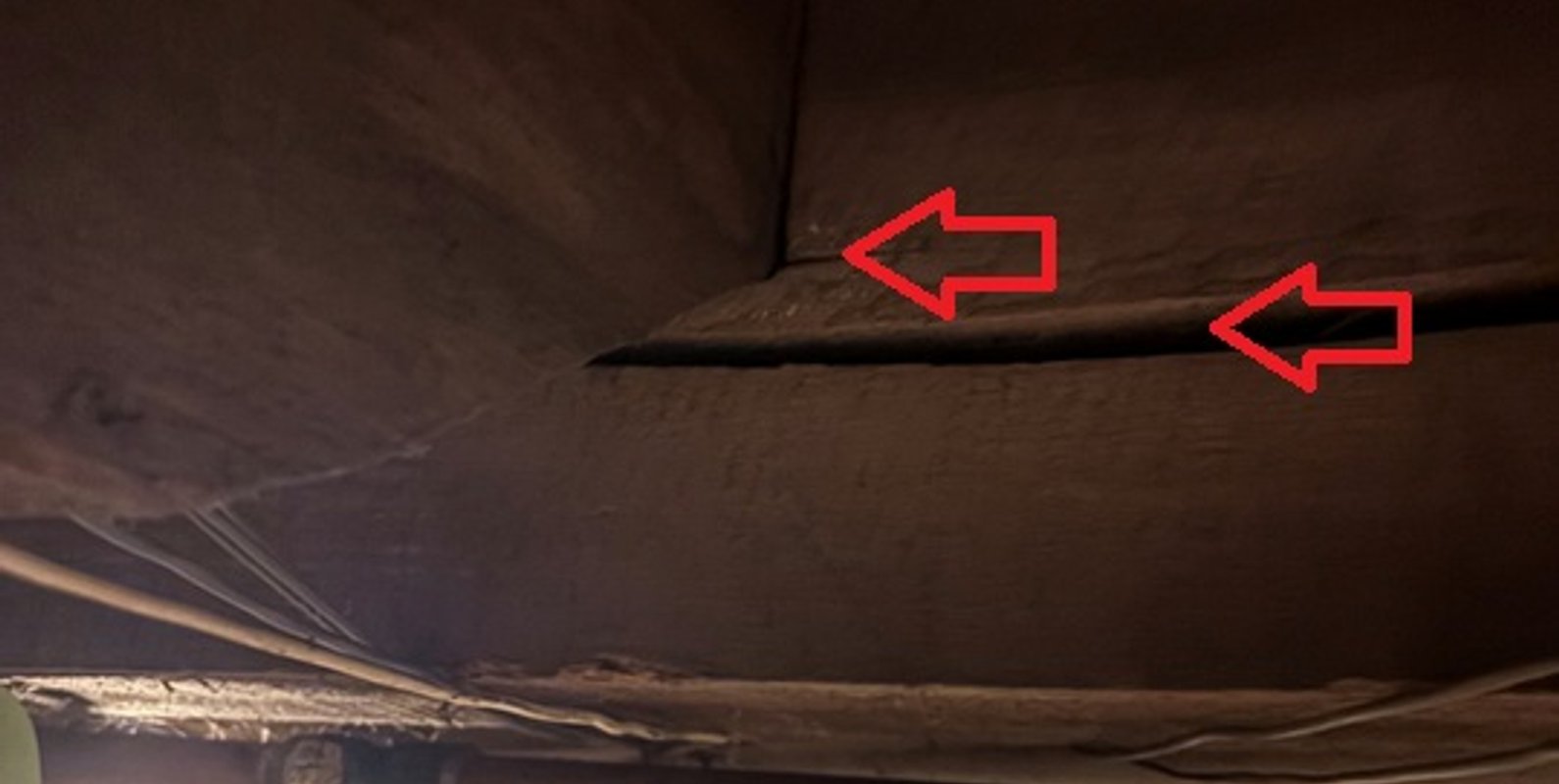
The most significant finding involved the primary wood beams running the length of the basement, which support the main portion of the home. Visual evidence indicated that these beams were experiencing early‑stage structural failure.
Specifically, cracking was observed beneath joist bearing locations along the beams. This pattern is consistent with tensile stress caused by loads exceeding the beam’s capacity. In other words, the weight being transferred from the floor joists to the main beams was likely greater than what the beams were designed to support—either due to age, material degradation, added loads from past renovations, or a combination of factors.
While no vertical splitting was observed (which would suggest more advanced failure), the cracking present was enough to warrant concern. Based on these observations, NextBLDG concluded that immediate temporary support was necessary to redistribute loads and prevent further damage. Long‑term corrective action would require replacement of the affected beams to restore structural integrity.
Importantly, similar stress indicators were noted on other primary beams in the basement, suggesting the issue was not isolated to a single location.
Secondary Findings: Floor Deflection in a Home Addition
A secondary structural concern was identified in a later addition to the home. In this area, floor tiles had cracked, and the subfloor exhibited a noticeable one‑ to two‑inch drop near an exterior wall. Although the underlying joists were not directly visible during this inspection, the amount of deflection strongly suggested inadequate joist support near the perimeter of the room.
NextBLDG recommended removal of finish materials including tile and subflooring to allow for a full inspection of the joists and proper reinforcement or repair as needed. Addressing this condition would help prevent continued movement and damage to finishes.
Foundation Condition Assessment
Despite the structural issues above, the home’s stone foundation was in relatively good condition for its age. Minimal signs of settlement were observed, and no major foundation distress was evident during the visual assessment. This distinction is important, as it indicates that the primary concerns were related to superstructure load paths rather than global foundation failure.
Why a Professional Engineering Inspection Matters
This Kirkville property highlights why a licensed engineering inspection is critical when cracks and uneven floors appear—especially in historic homes throughout upstate New York cities such as Syracuse, Auburn, Ithaca, Albany, Troy, and Rochester. Cosmetic symptoms often point to deeper structural causes that cannot be reliably diagnosed through a general home inspection alone.
By engaging NextBLDG, the homeowners received:
A clear explanation of why the cracking was occurring. An assessment of risk and urgency. Practical recommendations for both temporary stabilization and permanent repair. Professional documentation suitable for contractors, insurers, or future buyers
How NextBLDG Helps Homeowners Across Upstate New York
NextBLDG provides structural engineering inspections and evaluations for residential properties throughout upstate New York. Whether addressing cracked walls, sagging floors, aging beams, or renovation concerns, the firm focuses on clear communication and code‑informed recommendations.
For older homes in particular, NextBLDG helps owners understand how historic construction interacts with modern use, additions, and loading—and what steps are necessary to protect the structure long‑term.
Conclusion
In this Kirkville, NY inspection, early identification of beam overstress allowed for proactive recommendations before a more serious structural failure occurred. The home remains in generally good condition, but targeted structural repairs will be essential to preserve its safety and longevity.
For homeowners noticing similar issues, a professional engineering inspection can provide peace of mind and a clear path forward. NextBLDG continues to support homeowners across upstate New York with trusted, experience‑driven structural evaluations.